Tuesday, August 31, 2010

Product Review: Math Tutor DVD

Photobucket

I received two DVDs from Math Tutor, Young Minds: Numbers and Counting and The Basic Math Word Problem Tutor. Let me tell you a little about each.


Photobucket

The Young Minds video is a montage of beautiful scenes set to classical music. It teaches counting by using pictures that represent each number, 1-10. There are bonus features that include puzzles and games.

What We Thought
Because the intended audience is preschoolers, this DVD was not age-appropriate for any member of our household. However, I thought it was beautifully done and enjoyed watching it. This is a DVD that I would have watched over and over again with my boys when they were little, particularly during those times that we needed a quiet, sit-down moment. I give Young Minds two thumbs up.


The Basic Math Word Problem Tutor is approximately 8 hours in length and covers 15 different "types" of word problems- addition, subtraction, multiplication, and division, for example. Each session teaches students how to dissect the word problem. They are instructed to consider the question being asked and key words contained within. They are also given strategies for solving each type of problem.

What We Thought
Okay, you need to know that the Olive Plants family loves math. Solving word problems is something we would do for fun. So… unfortunately I cannot say that this DVD "worked for us". There were no a-ha moments.

However,! the methods the tutor uses are excellent. He breaks everything down into manageable chunks and gives his students an effective way to approach each problem. If you and yours are not math geeks like us, this DVD could be very helpful. I give it two perpendicular bisectors and a piece of pi!

The Young Minds DVD sells for $24.99, and The Basic Math Word Problems Tutor sells for $26.99. You can purchase them here.

I received both DVDs mentioned in this review for free. I have received no other compensation and have provided my honest opinion.

You can read more MathTutor reviews at the TOS Homeschool Crew blog.

solve math word problem

Why Do We Study Quadratic Equation?

In maths class, we are hammered with expressions after expressions of quadratic equations. We are taught how to solve for its roots. We are taught all the necessary methods or mathematical techniques to handle quadratic equations.

But after all these, what is the purpose?

This is the question many students of maths studies ask.

Do we need this "quadratic" knowledge in working life?

See the diagrams and photos below. They will enlighten you.


The communication dish is parabolic in shape. Parabolic is the equivalent to quadratic mathematically. Engineers need to understand quadratic equation to! design this beautiful profile.

This wok is designed using quadratic expression. With this, food can be fried to our liking!

Without quadratic equation, who knows how a wok would look like.

.

.


Here you see that eye-glass lens are constructed wit! h curves matching that of the quadratic equation.

L! ight is thus controlled to give good image to our eyes.

Quadratic equations to the rescue, right?

.

.

.

.

.

.

Other examples are:

1) Distance travelled given by the quadratic equation s = ut + (1/2) a t2

2) Electrical characteristics of a MOSFET (Transistor device)
i = k [(Vg - Vt)VD - (1/2)Vd2]

So now do you still wonder why you study quadratic equations?

Maths do have a purpose in our daily life. Rest assure that you are studying maths for a good cause.

:-)

quadratic equations calculator

ECO 509 - Spring Quarter 2008

Next quarter (Spring 2008) I'll be taking ECO 509 - Business Conditions Analysis (aka Macroeconomics) with Professor Jaejoon Woo (Wed night section).

You can find the blog for ECO 509 at http://eco509.blogspot.com.


prediction interval calculator

My letter to the prime minister - have you written yours?

Subject: Censorship
Comment:
Dear Prime Minister,

I remain concerned about the government's plans to introduce further
censorship of the internet, and about the issues of censorship and freedom of
expression more generally. In particular, I remain angry about the highly
unhelpful response by the former prime minister to the attacks on Bill
Henson, and on the arts community in general, only two years ago.

In my view, there is no issue more important than the long-term protection
and extension of liberal freedoms. There has been far too much retreat from
strict application of the Millian harm principle and the principle of freedom
of speech and expression. This has affected many areas of government policy
under Prime Ministers Howard and Rudd. The current proposals to censor the
internet are of particular concern, given the endless possibility to use the
proposed mechanisms to censor expression that goes far beyond what is claimed
to be the main target: i.e., child pornography.

If child pornography is operating at a level that is causing genuine anxiety
within the government - and this is not just a matter of moral panic - then
more funding should be devoted to ordinary law enforcement to attack the
problem. However, the concept of child pornography must be kept within fairly
narrow limits, so that it can never attach to legitimate artistic images,
such as those created by Henson or the image of Olympia Papapetrou that was
used on the cover of a 2008 issue of Arts Monthly. In any event, it is likely
that child pornography is not spread mainly via publicly-accessible websites,
and that internet censorship will have little effect on it. If so, the
government's current proposals are a dangerous waste of resources.

We need to be confident that whatever steps are taken by the new government
will enhance, rather than further reduce, freedom of speech and expression.
If any measures are introduced, they must be protected from scope creep.
Restrictions on speech relating to such issues as euthanasia must be
liberalised, not hardened up. Importantly, Senator Conroy must stop attacking
free speech advocates as friends of pedophiles - this repeated slur has
caused enormous ill-will towards the government, to the extent where many of
us have lost all confidence in Senator Conroy and hope that he will be
removed from his current portfolio. That is obviously not possible during the
election period, but the signals from both him and yourself during the coming
weeks will be watched closely.

I hope that you will continue to give serious consideration to these matters
as 21 August approaches. Frankly, I am not eager to vote for the Opposition,
and will likely give my first preference to a minor party. Exactly how I vote
will, however, depend heavily on the responses of the major parties to free
speech issues. I need to know that these issues are taken seriously and that
I can look forward to further extension of our liberal freedoms, not to a
retreat into the mentality of censorship.

Yours sincerely,

Russell Blackford

prime expression

Mcat & being physci, neurosci

The great part about being a physiological science major and neuroscience minor is that you dont have to freak out about the following topics on the mcat bio section:

Eukaryotic cells

Enzymes

Nerve cells/neural tissue

Muscle cells/contractile mechanisms & processes

Other specialized cell types

Endocrine system: hormones & their action mechanisms

Nervous system: structure, function, sensory reception & processing

Circulatory system

Lymphatic system

Immune system: innate & adaptive systems

Digestive & excretory systems

Muscle system: function, structure, nervous control

Skeletal system

Respiratory system: structure, function, breathing mechanisms

Skin system: thermo, osmo regulation, structure, function

Reproductive system

embryogenesis

And a bunch of other things

mcat question of the day

How to Graphing Inequalities in the Coordinate Plane.

Objective:
  • Graph inequalities in a xy coordinate graph.


Assumptions:!

  • Ability to graph a line using the slope-intercept form (y = mx + b)


Concepts:

  • The shaded area of a graph represents all of the coordinates that will work in a given equation.
  • A solid edge of the shaded area means that the e! dge is part of the solutions to the equation.
  • A dashed edge of the shaded area means that the edge of the graph is not part of the solutions.


Directions:

Graph the equation

Step 1: Draw the graph just as you would y = x . This equations in slope intercept form would look like this . The 0 means that you will go through the origin, place a point there. Now use the slope to draw the rest of t! he line. From the origin go up one and to the right one and pl! ace anot her point. Repeat until you have several points.

Now draw a solid line because the equation to be graphed is greater than or equal to. Your graph should now look like this:

Step 2: Next shade everywhere above the line because the equation states that the y values are greater than or equal to the line for any given x value.

Now check your answer by inserting a couple of points from the shaded area and non-shaded area.

Shaded

Does the point ( 1, 2) work in the equation? yes

Does the point ( -1, 0) work in the equation? yes

Non-shaded

Does the point ( 1, 0) work in the equation? no

Does the point ( 2, 1) work in the e! quation? no


Lets try another one.

Graph graph y > 2x + 3

Remember the steps: plot some points, draw the line (solid if equal to, dashed if greater than or less than), shade above with greater than, shade below with less than.

The line will cross the y axis as 3 then go up 2 and over 1 for the slope. Start by placing a point at 3 on the y axis. Next use the slope to place 2 more dots, then make a dashed line through the dots.

The equation uses the greater than inequality so it should be shaded above the line.


Now that we have the common ones out of the way lets look at the ones that may trip you up such as the ones with only one variable like y > 2 and x < -3.


Graph y > 2

Remember that is just a horizontal line. This is just a horizontal line that is shaded above the line and dashed because it is not equal to the line it is only greater than the line.


Graph x < -3

Remember that is just a vertical line. This is just a vertical line that is shaded to the left of the line and dashed because it is not equal to the line it is only less than the line. The x values on the left are less than the line.


Things to remember when graphing inequalities:

Solid line and shaded above the line.

Solid line and shaded below the line

> Dashed line and shaded above the line


y > # Horizontal line and shaded above the line

y < # Horizontal! line an d shaded below the line

x > # Vertical line and shaded on the right side of the line

x < # Vertical line and shaded on the left side of the line.


line graph generator

Kinds of set

1. Finite set – countable
Example: Sets A, B, C, D are finite sets

2. Infinite set – uncountable
Example: Set E is an infinite set

3. Empty or null set – has no element
Example: A = { }

4. Equal set – set A and set B are equal set if the elements of set A is exactly the element of set B.
Example:
A = {set of an even counting number of one digit} = {2,4,6,8}
B = {set of an integral multiples of two having one digit = {2,4,6,8}

5. Equivalent set – two sets are equivalent if there exists a one-to-one correspondence between elements of the two sets.
Example:
A = {1, 2, 3, 4,5} - x coordinate
B = {6, 7, 8, 9, 10} – y coordinate

then &! #8220;A” is equivalent to B. We can construct the relation of set A and set B.

{ (1,6}, (2,7), (3,8), (4,4), (5,10) }

6. Subset – set whose elements are members of the given set A = {1,2,3,4,5,8}, B = {2,4,8}

7. Universal Set – totality of the given set with consideration. The set from which we select elements to form A given set is called universal.
Example:
Set A = {1, 2, 3, 4, 5, 8} is a universal set
Set B = {2, 4, 8} is a subset of set A

8. Disjoint Set – sets that has no common element ; if two sets have no element in common, the sets are called disjoint sets.

kind of sets

Polynomial Division 3: Applications To Arithmetic Division

This post is, once again, a summary of a longer post authored by me on my own blog. My blog covers a lot of areas, including Vedic Mathematics. If you are interested in reading my thoughts on other topics, please feel free to visit my blog and post comments on the other articles you find there also! Thank you!

In the previous lesson, we saw how we can extend the method we developed for polynomial division by linear divisors in this earlier lesson to divisors of higher degree. In this lesson, we will now look at some applications of this methodology for arithmetic division.

Before we proceed, we need to be clear that arithmetic division is a messy problem. We have dealt with arithmetic division using different ! methods in some previous lessons (here, here and here). Using polynomial division techniques for arithmetic division is just one more tool to tackle division that we can add to our arsenal. It is not a magic bullet that is going to make division trivial. But, the more tools we have in our arsenal, the better off we are.

As in this earlier lesson, using polynomial division techniques for arithmetic division relies on our ability to express numbers as polynomials. There is not a single way to express numbers as polynomials, but a multitude of them. In fact, each numeric ba! se will result in a different polynomial expression of a numb! er. The most common numeric base, of course, is 10. Most of this lesson will therefore rely on using 10 as a base in converting numbers to polynomials, but there is no rule that says the base has to be 10. We can use any other power of 10 or any random number such as 2, 3, 14 or whatever else we think will make the problem easier to tackle.

Let us first tackle the simple case of dividing 32895 by 123. It is easy to see that this can be rewritten as dividing 3x^4 + 2x^3 + 8x^2 + 9x + 5 by x^2 + 2x + 3, where x = 10 (thus we have used a base of 10 to convert the numbers into polynomials). Since the divisor contains 3 terms, we need to arrange our dividend into groups of three terms. We also notice that the ratio of coefficients in the divisor is 1:2:3. So, the ratio of coefficients in each of the groups of three terms in the dividend has to 1:2:3 also. Based on this, we see that the following expression of the dividend will work:

3x^4 + 6x^3 ! + 9x^2
- 4x^3 - 8x^2 - 12x
+ 7x^2 + 14x + 21
+ 7x - 16

This will then lead to the following factorization:

3x^2(x^2 + 2x + 3) - 4x(x^2 + 2x + 3) + 7(x^2 + 2x + 3) + 7x - 16

We can then collect the terms and conclude that the quotient is 3x^2 - 4x + 7, which is simply 300 - 40 + 7 = 267. Similarly the remainder is 7x - 16, which is simply 70 - 16 = 54. We can easily check to make sure that 267*123 + 54 = 32895, so we have performed the division correctly.

Consider another problem, 38979 divided by 132. Using x = 10 as our base, we can express this as the polynomial division of 3x^4 + 8x^3 + 9x^2 + 7x + 9 by x^2 + 3x + 2. We need to express the dividend as groups of three terms, with the coefficients within each group being in the ration 1:3:2. We then write the dividend as below for factorization:

3x^4 + 9x^3 + 6x^2
- x^3 - 3x^2 - 2x
+ 6x^2 + 18x + 12
- 9x - 3

Fa! ctorization of the dividend gives us:

3x^2(x^2 + 3! x + 2) - x(x^2 + 3x + 2) + 6(x^2 + 3x + 2) - 9x - 3

This will give us a quotient of 3x^2 - x + 6, which is 300 - 10 + 6 = 296. We get a remainder of -9x - 3 = -93. We see that the remainder is negative. This is not the standard way in which the results of a division problem are presented. But the way around it is quite simple. We simply have subtract one from the quotient, and add the divisor to the remainder. Repeat this process until the remainder becomes positive. This procedure then gives us a final quotient of 295, and a final remainder of 39. I encourage you to verify that the answer derived here is indeed correct.

Now consider the division of 56424 by 1421. We can express this as the division of 5x^4 + 6x^3 + 4x^2 + 2x + 4 by x^3 + 4x^2 + 2x + 1. This will require the expression of the dividend in the form of groups of 4 terms, whose coefficients are in the ratio 1:4:2:1. This can be accomplished by expressing the dividend as belo! w:

5x^4 + 20x^3 + 10x^2 + 5x
- 14x^3 - 56x^2 - 28x - 14
+ 50x^2 + 25x + 18

This can be factorized as:

5x(x^3 + 4x^2 + 2x + 1) -14(x^3 + 4x^2 + 2x + 1) + 50x^2 + 25x + 18. This yields us a quotient of 5x - 14, which is 36 when x = 10. We also get a remainder of 50x^2 + 25x + 18, which is 5268 when x = 10. Obviously, this is not the answer expressed in standard form since the remainder is much higher than the divisor. However, the situation is easy to correct. All we have to do is subtract the divisor from the remainder and add 1 to the quotient. Repeat until the remainder becomes smaller than the divisor. Following that procedure, we get a final quotient of 39, and a final remainder of 1005. You can verify that this indeed the correct answer.

Now, let us consider 435323 divided by 212. Once again, we can express this as 4x^5 + 3x^4 + 5x^3 + 3x^2 + 2x + 3 divided by 2x^2 + x + 2, where x = 10. We on! ce again have to arrange the dividend in groups of 3, and the ! coeffic ients within each group have to be in the ratio 2:1:2. Based on this, we rewrite the dividend as below:

4x^5 + 2x^4 + 4x^3
+ x^4 + 0.5x^3 + x^2
+ 0.5x^3 + 0.25x^2 + 0.5x
+ 1.75x^2 + 0.875x + 1.75
+ 0.625x + 1.25

As you can see this is getting a little messy, but let us proceed with the factorization as below:

2x^3(2x^2 + x + 2) + 0.5x^2(2x^2 + x + 2) + 0.25x(2x^2 + x + 2) + 0.875(2x^2 + x + 2) + 0.625x + 1.25

This then gives us a quotient of 2x^3 + 0.5x^2 + 0.25x + 0.875. Substituting x = 10 in this expression gives us 2000 + 50 + 2.5 + 0.875 = 2053.375. The remainder is 0.625x + 1.25, which is 6.25 + 1.25 = 7.5, when x = 10. This answer is correct, but it is obviously not in standard form, where we expect our quotients and remainders to be whole numbers. To get rid of the fractional part from the quotient, let us take the fractional part, 0.375 (which is 3/8), multiply it by our divisor, 212, ! and add it to our remainder. This then gives us a final quotient of 2053, and final remainder of 7.5 + 212*3/8 = 87. We can verify that 2053*212 + 87 = 435323. So, not only was the division performed correctly, but we also managed to get the results into standard form without much difficulty.

Now, let us see how we can use polynomial division techniques to perform the division of 369670 by 1212. There are actually two ways to tackle this problem. The more traditional way is to consider this to be the division of 3x^5 + 6x^4 + 9x^3 + 6x^2 + 7x by x^3 + 2x^2 + x + 2. This would necessitate the expression of the dividend as groups of 4 terms, whose coefficients are in the ratio 1:2:1:2. This is accomplished by writing the dividend as below:

3x^5 + 6x^4 + 3x^3 + 6x^2
+ 0x^4 + 0x^3 + 0x^2 + 0x (note that this line can be skipped entirely)
+ 6x^3 + 12x^2 + 6x + 12
- 12x^2 + x - 12

This can be factorized as:
!
3x^2(x^3 + 2x^2 + x + 2) + 6(x^3 + 2x^2 + x + 2) - 12x^! 2 + x - 12

This gives us a quotient of 3x^2 + 6, which is 300 + 6 = 306, and a remainder of -12x^2 + x - 12, which is -1200 + 10 - 12 = -1202. Since the remainder is negative, we add the divisor to it and subtract 1 from the quotient. This gives us a quotient of 305, and a remainder of 10. One can verify that this is the correct answer.

But there is another way to approach this problem using the principle of polynomial division. We can also express it as the division of 36x^2 + 96x + 70 by 12x + 12, where x = 100. Now, we see that the divisor terms are in the ratio 1:1, and the divisor terms have a common factor of 12. We can choose to take care of the common factor in two different ways.

In the first case, let us divide by the dividend terms by the common factor before we factorize. This gives us:

3x^2 + 8x + 70/12

We then express the dividend in groups of two terms, with the coefficients in each group bein! g the ratio 1:1. This gives us:

3x^2 + 3x
+ 5x + 5
+ 10/12

This can be factorized as:

3x(x + 1) + 5(x + 1) + 10/12

This gives us a quotient of 3x + 5, and remainder of (10/12)*12 = 10 (remember that in this method, the remainder has to be multiplied by the common factor to get the final remainder as explained this earlier lesson). Substituting x = 100 in the quotient expression, we see that we once again get a quotient of 305 and a remainder of 10.

The other way to handle the common factor is to ignore it initially, and divide the quotient by 12 after the factorization (remember not to divide the remainder by the common factor if you do it this way, again as explained in this earlier lesson). Using this te! chnique, we can rewrite the dividend as below:

36x! ^2 + 36x
+ 60x + 60
+ 10

This then factorizes out as below:

36x(x + 1) + 60(x + 1) + 10

This then gives us a quotient of 36x + 60 and a remainder of 10. We divide this quotient by the common factor, 12, to get a final quotient of 3x + 5, which is equal to 305 when x = 100. The final remainder is 10, as before.

The example above is a demonstration of how changing the base in which we do our calculations can sometimes lead to shorter, easier and quicker calculations.

For an example of how to use vinculums (dealt with in this earlier lesson) to make some division problems easier than they would be otherwise, please read my full lesson here. The use of such creative techniques is sometimes necessary to solve division probl! ems if we don't want to use brute force. Keeping these various techniques in mind and applying them at the correct time under the right conditions is essential when you want to solve problems mentally, and the first technique that comes to mind is not the ideal method to tackle the problem with.

Hope this lesson has provided you with a wide variety of examples of solving arithmetic problems using polynomial division techniques. As mentioned at the beginning of this lesson, division is never a trivial problem, and it is impossible to make it universally easy in any system of mathematics. However, having a large arsenal of tools to rely on and using the right tool at the right time is the secret to tackling them effectively. Good luck, and happy computing!

how to do polynomials

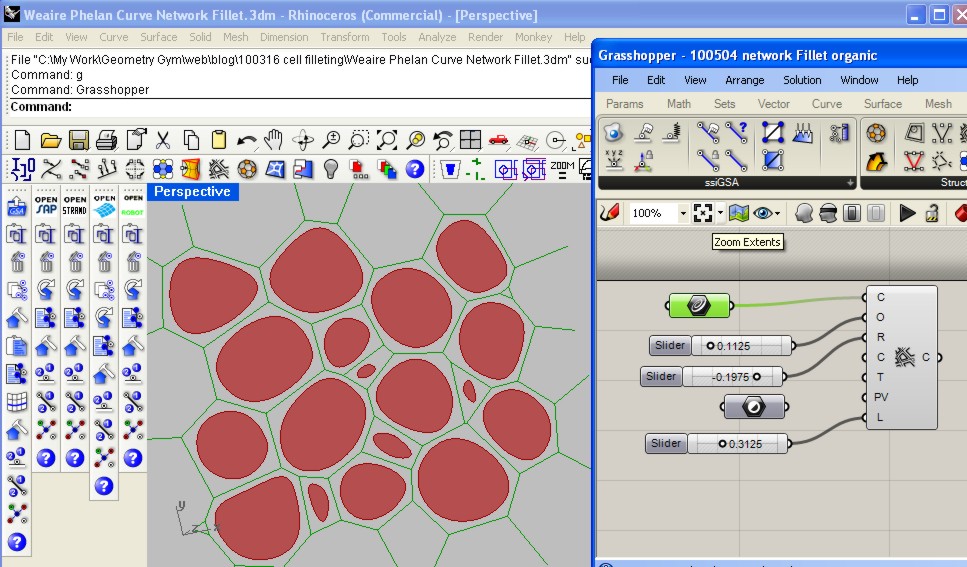
Tessellation in Grasshopper (Beijing Watercube revisited)


I've started enabling the tessellation (polygon packing) routines in Grasshopper, and the Bejing Watercube is such a great example of using this geometry I thought I'd post the grasshopper version.
Rhino file from here.
Grasshopper definition here.

I've also started implementing some spline variable cell filleting, I'm still looking at options for generating best results.  An improvement on constant radius results.

geometry shape definitions

hw: 4/23

hw: ws 11.1

factoring by grouping calculator

Materi Pembelajaran MODERNISASI PENDIDIKAN PESANTREN

KEBERADAAN pesantren yang tetap survive sampai sekarang tentu menjadi kebanggaan tersendiri
bagi umat Islam. Di tengah arus globalisasi, individualisme, dan pola hidup materialistik yang kian
mengental, pesantren masih konsisten menyuguhkan kitab kuning dan sistem pendidikan yang oleh
sebagian orang dianggap tradisional. Pengajaran kitab-kitab kuning (klasik) adalah salah satu elemen
dasar dari tradisi pesantren di samping kiai, pondok, masjid, dan santri.
Doktrin-doktrin dalam kitab kuning, yang senantiasa merujuk Al Quran dan Sunah Nabi sebagai
sumber utama, merupakan salah satu roh yang menjiwai kehidupan pesantren. Seluruh sisi kehidupan
pesantren bersifat religius-teosentris, sehingga semua aktivitas pendidikan dipandang sebagai ibadah
an sich kepada Tuhan. Aktivitas belajar, misalnya, bukan hanya diposisikan sebagai media (alat), tetapi
sekaligus sebagai tujuan. Karena itu, proses belajar-mengajar di pesantren sering kali! tidak mengalami
dinamika dan tidak memperhitungkan waktu, strategi, dan metode yang lebih kontekstual dengan
perkembangan zaman.
Padahal, seiring pergeseran zaman, santri membutuhkan formalitas-sebutlah seperti ijazah serta
penguasaan bidang keahlian (keterampilan) tertentu-yang dapat mengantarkannya agar mampu
menjalani kehidupan. Di era modern santri tidak cukup hanya berbekal nilai dan norma moral saja,
tetapi perlu pula dilengkapi dengan keahlian dan skills yang relevan dengan kebutuhan dunia kerja
modern.
Berkaitan dengan hal tersebut, pada dekade terakhir sebagian kaum santri memperlihatkan
kecenderungan untuk mempelajari sains dan teknologi di lembaga-lembaga pendidikan formal di luar
pesantren. Namun, pada saat yang sama mereka juga enggan meninggalkan pesantren sebagai
wahana untuk mendalami agama dan memperteguh nilai-nilai moral. Gejala ini menyiratkan adanya
kegelisahan sebagian kaum santri dalam meres! pons tuntutan modernisasi yang tak mungkin dielakkan.
Ken! yataan d i atas seharusnya dapat melecut mereka yang berkompeten dalam pengembangan
pesantren agar melakukan langkah-langkah transformatif, bila pesantren akan dijadikan sebagai
institusi pendidikan yang menjanjikan pada era modern. Kini saatnya bagi pesantren untuk melakukan
reorientasi tata nilai dan tata operasional pendidikannya, agar lebih relevan dengan dinamika
kemodernan, tanpa meninggalkan nilai-nilai tradisional yang telah lama mengakar kuat di pesantren.
uuu
DI antara sekian persoalan dalam sistem pendidikan pesantren, masalah metodologi belajar-mengajar,
visi dan kerangka dasar kurikulum pendidikan sangat penting untuk dikaji ulang dan disempurnakan.
Misalnya, fokus utama metode halaqah sebagai metode bersama antarsantri untuk memahami ajaran
kiai (ustad) dan isi kitab, selama ini masih mengacu pada pertanyaan dari sisi ''apa'' dan guna
''memiliki'' ilmu-ilmu yang diajarkan kepada santri. Dalam praktiknya, metode ini lebih! menekankan cara
menghafal tanpa disertai sikap kritis.
Metode halaqah perlu ditingkatkan menjadi forum dialog. Melalui dialog akan berkembang bukan saja
pertanyaan dari segi ''apa'' dan ''memiliki'', tapi juga pertanyaan dan pemahaman tentang ''mengapa''
dan ''bagaimana'' perspektif atau perkembangan ilmu-ilmu tersebut di masa mendatang. Dengan begitu
santri akan memandang ilmu bukan hanya sebagai sesuatu yang harus dimiliki sebagaimana adanya,
tetapi juga memaknainya sebagai sesuatu yang harus dikembangkan, sekaligus sebagai sarana untuk
mengembangkan kepribadian intelektualnya.
Masih berkenaan dengan metode belajar-mengajar, yang tak kalah penting adalah mengenai masa
belajar di pesantren yang relatif panjang. Padahal, prinsip masyarakat modern cenderung
praktis-pragmatis. Prinsip ini tidak hanya berlaku di sektor ekonomi saja, tetapi juga mulai merambah
dunia pendidikan. Masalah ini akan dapat diatasi kalau pesantre! n mampu melakukan transformasi
terhadap metode belajar-me! ngajar, kerangka dasar kurikulum, dan visi pendidikannya.
Di banyak pesantren tradisional, pengajaran kitab-kitab kuning berbahasa Arab, baik secara
''bandongan'' dan ''sorogan'', memiliki kelemahan metodologis yang memprihatinkan, karena para
santri tidak dibekali terlebih dahulu dengan keterampilan berbahasa Arab yang memadai. Akibatnya,
santri hanya mampu menguasai kitab yang pernah diajarkan saja, serta lemah dalam mengkaji secara
mandiri kitab-kitab yang belum pernah dipelajari. Kelemahan metodologis ini juga menyebabkan masa
belajar yang ditempuh santri menjadi lebih lama.
Dalam melakukan usaha-usaha transformatif-antisipatoris terhadap sistem pendidikan yang
dijalankan, pesantren perlu mempertimbangkan aspek-aspek substansial. Di antaranya, selayaknya
santri tidak hanya diposisikan sebagai subyek pasif, tetapi harus diperlakukan sebagai subyek yang
aktif-kritis. Di samping itu, salah satu jalan yang bisa dilakukan guna mendoro! ng kreativitas santri
adalah dengan membudayakan tradisi membaca dan menulis. Dengan ini diharapkan mereka menjadi
individu yang dinamis dan responsif terhadap dinamika perubahan sosial, budaya dan politik, tanpa
kehilangan prinsip-prinsip keagamaan sebagai pegangan hidup.
SUMBER TERKAIT :
NIHAYATUL WAFIROH
Editor majalah Iftitah PPP Darussalam Banyuwangi dan alumnus PPP
Al Fathimiyyah Tambakberas Jombang
o v x y z www.smu-net.com ... Portal Pendidikan SMUnet

------------------------------------------------------------------------------------


f x g x

Why ALEKS Provides "the Best" Math Software

Many different online programs for math instruction/assessment exist.  ALEKS stands out.  If teachers or administrators misunderstand its design, their choice of other programs will be arbitrary.  They will be merely victims of marketing, not arbiters of what's best for student learning.

The internal research conducted by ALEKS on its software appears to be extensive.  Every topic network is constantly and automatically checked.  If less than 90% of students pass any topic, then the network to the question is re-verified.  In other words, after a decade of iteration, the learning progression in ALEKS is second-to-none.  However, to satisfy the various state standards, additional topics are introduced into standard curricula like Algebra 1 for coverage.  These additional standards add redundancy to the network at a price of increased time (more topics) to master a course.

ALEKS uses time more efficiently than any other math program.  This is easy to show.  First, ALEKS uses constructed responses only, not multiple choice. Fewer correct answers are needed to show mastery; since multiple choice inherently requires more questions to cope with  false positives due to random guessing.  Second, the ALEKS web of topics and intentional time delay in verifying mastery drive efficiency.  No topic is offered until the student has a 90% chance of "passing it" due to completing a network of prerequisites.  Also, while usually only four correct answers are necessary to complete a topic, one more topic question is presented days or weeks later to verify mastery.  A wrong answer brings the topic back.  Third, its artificial intelligence engine further separates ALEKS from most other programs.  It appears to use the time-to-answer a sequence of questions correctly to determine how many q! uestions are needed.  Sometimes a student only needs to answer two questions to complete a topic (Mastery verification is later.). In short, there is no faster method than ALEKS to develop procedural math mastery.

As part of its interface design, ALEKS doesn't display information that the student doesn't need.  For example, neither the time on the question nor the menus of topics is displayed; although ALEKS does record time, when the student is working on a problem.  ALEKS wants students focused on the question without distraction.  There is research behind this decision. Additionally, ALEKS chose to use Java extensions to provide online protractors, rulers, etc to produce its online manipulatives.  This standard software can either be automatically retrieved (www.aleks.com/plugin) or installed.  Most other companies use Flash for interactions.  These work well, but are losing their position of being an Internet standard.  In addition, ALEKS uses natural display of answers and allows for variations in the answer of questions.  These features relax students and minimize their frustration - not a small issue.

The last two paragraphs covered Assessment & Interface Design. of the six main aspects of online math software.

ALEKS receives the most criticism on its Instructional Design.  In general, the criticisms are ill-considered. First, instruction is offered only when students request it.  There are no hints, and students know that they will have to do more work, if they ask for instruction.  This motivates students to try to solve problems first and, if unsuccessful, to pay close attention to solutions because they don't want to learn more than once.  Second, the instruction is simply text with graphics, no videos. While unappealing initially, they fit how most students actually do math.  For example, few students read math textbooks.  They attempt problems, then look for examples on how to do them as quickly as possible. ALEKS's instructions quickly suffice.  From another perspective, video with sound appears wonderful, but it can distract and requires computers with headphones. ALEKS works quickly and quietly even in dial-up environments.  M! ore importantly, videos frequently waste time.  Students just look at them in a daze. The low density of information in a video is rarely worth the time to most students.  One exception exists.  Buzzmath has annotated videos, which allows students to skip sections they don't want to see so that they can go to what they want quickly.  ALEKS could offer such a service as an upgrade. 

Intermixed with Assessment Design is Database Design.  ALEKS satisfies the main math problem criterion:  whether through randomization or question quantity, the number of questions per topic is far more than what can be shared between students.  In short, cheating by having shared question/answer lists is squelched by ALEKS and several other programs.  Another subtle feature is the speed of the database when reports are being generated.  ALEKS is so fast, that the browser refresh rate appears slower.  Other programs, such as APEX, have slow to generate reports. From a teacher usage perspective, fast reports are critical.

The bars and circle charts in ALEKS's reports are easy to understand.  Many have hyperlinks to other reports which greatly saves time.  The only program with better reports may be Daskala, which is limited to simple sequences of multiple choice questions.  ALEKS reporting could be improved by an all student-class report. This is a small issue, but teachers who have students spread between many classes, have to remember what class a student is in to find the student's status.  It would be valuable to have a list report of students and their classes with hyperlinks to the student's report.

The one area in which ALEKS can improve, or at least freshen, is account management.  ALEKS works with active licenses, which is the best method, but ALEKS lacks ease in both enrolling students and also in identifying unenrolled users.  The information is there, but it is tedious to use.  On the other hand, unlike many other active license software vendors, it doesn't lose data on previous students. A simple list with fields would resolve the enrollment issue.

The great issue with ALEKS is that it intentionally rejects rich problems - problems that require strong student insight and drawing from multiple sources to find solutions.  This is contentious.  Research by ALEKS probably shows what I see in the classroom: many, perhaps the majority, of independent students simply stall out when confronted with problems that stretch them too much.  This is sad, but it may just indicate that the desire for math software to do everything - no classroom needed - is a false dream, not research-based.  The 90% rule really means a great deal to ALEKS's programmers.  Mastery of procedural skills is the goal. The subtleties of applications are left to classroom instruction.

A superb product with richer problems is Carnegie Tutor, CT.  Since questions are rich, each question has many objectives built into it.  When student cannot solve a problem, the instructional help to get through it; including the teacher, requires considerable time, and is inherently different for each student!  CT does have underlying artificial intelligence, but it is results are still linear.  If a student is stuck, they must stop.  This is a prescription for failure in many computer environments, but CT offers  appealing instruction. Another program with rich questions is StudyIsland. Good students are attracted to it. If a student struggles, StudyIsland, like ALEKS, allows students to work on other topics.  In short, students stay working - the great benefit of student choice.  StudyIsland even incorporates some simple AI to g! ive students easier questions in a topic, if the grade level questions are causing failure.  This appears wise, but the ALEKS approach of moving the student through a network of topics, not a flow of topics within the same top-level topic shows far more sophistication in improving the transferable skills of each student.

The more problems that students complete as practice, not experience, each hour, the better!  In my observations, only SmartMath and IXL, have higher problem completion rates, with SmartMath having more concentrated practice, but these are K-6 programs!  Student choice - for whatever reason, like fatigue or boredom - should be allowed.  It keeps students working.  Also, in years of ALEKS and SmartMath usage, not one question mistake has been found by me.  APEX is riddled with errors, iPass has problems, and StudyIsland has a software link to report mistakes, to which StudyIsland responds promptly.  IXL only has a few errors.  This issue is missed in software evaluations.  Maintaining confidence in the software is an important issue in the value of the software.

In summary, ALEKS does its jobs exceptionally well on three of six categories: Assessment, Interface, and Database.  On the two categories Account Management and Reports, ALEKS is very good.  Yet, strangely, in Instructional Design, ALEKS is either the best or inadequate, depending on a reviewer's knowledge and/or desires.  ALEKS Corporation has decided to focus its software on what they believe works best in software, from a research basis.  Others want a full, rich instructional system which is a desirable goal.  This may be an example of the best being the enemy of the better.  More may be desired in instructional capabilities and in rich problems, but it is not clear whether or not this is valid with more than a few students.  ALEKS thinks not; and ALEKS could easily deliver additional features.  In the years I've used ALEKS, the company has grown from 20 to 120 employees.  More importantly, ALEKS retains its earnings and pour! s it into development.  It is not a cash cow. ALEKS provides the fastest pathway to procedural fluency.  Asking software to do more may be unwise or self-delusional.

Lastly, pricing matters.  It's easy to forget that software providers are businesses that pay not only for programmers, but also for salespeople, customer service representatives, clerks, brochures, trade shows, etc.  Years ago, in a private conversation with an ALEKS executive, I was told that to go below $42 average per user would kill R&D over time.  Obviously, large school districts could bargain for a better price and home users, with their many customer service interactions, would have to pay more, but to maintain the average was vital. I never forget this when purchasing other software at 5 -10$ per user, which I frequently do.  These programs may not be able to keep improving without venture investments, and programs that cost over $100 per year - many do - may not maintain steady users.  ALEKS's pricing allows sustainability and improvement year after year.

--------------

Dennis Ashendorf has extensively used the following:
  • ALEKS
  • APEX
  • iPass
  • IXL
  • RevolutionPrep
  • SmartMath
  • XLPrep
Dennis Ashendorf has lightly used
  • Carnegie Tutor
  • STMath

apex learning answers

Mr. Giraffe Solves Your Linear Algebra Problems

Please Note: If I made any mistakes in this test, perhaps this picture of a giraffe will convince otherwise.


answer to algebra problems

Algebra is an area of mathematics that use alphabetic characters in place of numbers to derive results for a given situation.

Algebra – Studying for Real Life


source


http://www.math-worksheets.co.uk/


What is Algebra?

It is an area of mathematics that use alphabetic characters in place of numbers to derive results for a given situation. This abstraction is the very reason why most people find algebra scary and too difficult to handle and it is the same reasons why some students find it fun to play around with. Algebra topics extend by working through simple tasks such as factoring binomials and eventually progressing on to finding the product of matrices. Most individuals begin to learn Algebra by adding, subtracting, reducing and simplifying algebraic expressions. They then move on to understanding equivalent fractions, finding Least Common Multiples (LCM) and converting fractions to decimals.

Oh no! It’s Exponents, Radicals and Graphing

There are many higher level themes. First there are powers. A power is the little number placed to the right and slightly above a number or algebraic expression. An example is (x + y)3 where the 3 is the power and denotes the power to which that number is raised. The above algebraic expression is expressed as, x plus y to the third power. In working with powers you can add, subtract, multiple or divide them . You can work with rational and negative exponents. If that isn’t enough to make your head spin, then you can move on to radicals. A radical, in simple terms, is the reversing of an power. Radical expressions ! are deno ted by the symbol “V” and when placed beside number 4, it is read as square root of 4, which is equal to 2. The opposite exponential equation is 2^2 which is read, 2 to the 2nd power, and equals 4. Equally with exponents, radical expressions can be added, subtracted, multiplied and divided. Radicals can be converted into exponents and exponents back into radicals. If exponents and radicals aren’t enough, there is always graphing. Start with graphing straight lines and determining if the line is horizontal or vertical or something else. Another question to ask is whether the line has an x-intercept or a y-intercept Can you find the slope of the line? you master the mathematical art of graphing, you will come across a whole new world filled with parabolas and hyperbolas.

Help is Out There

While you are learning algebra if the terms and concepts seem too much to handle, relax and take a break. There are many reso! urces out there that can help you master quadratic systems of equations, quadratic formulas and polynomials. Look for math tutors or software systems that will walk you through gradual process on how to solve any problem. You can also use algebra calculators or algebra solvers. any of these tools can assist you become an algebra expert in no time.


radicals and exponents

Polynomial Division: Long and Synthetic

Rather than explaining in lots of detail how to divide polynomials either using the long method or the synthetic method, I am sending my students to the following site. This PowerPoint is very brief, but it is very informative and shows every step of each process. Once the presentation is open, just press F5 to begin the slide show. A space bar or enter will move the slide show forward. The backspace key will back up if you need to see something again.

Problems on Quadratic Forms

It's Geometry! Parallel and Perpendicular lines.


It's Geometry Monday!

parallel and perpendicular lines

J7-Number 30 Bus, Tavistock Square

J7 Incident Analysis: Number 30 Bus, Tavistock Square


9.47am Tavistock Square, Number 30 Bus Explosion

At 9.47am on 7 July 2005, almost an hour after the events underground, an incident occurred on a number 30 bus outside the offices of the British Medical Association in Upper Woburn Place/Tavistock Square. The number 30 bus explosion is perhaps the single most important of all the incidents that occurred on 7 July 2005, simply because it was the only one to occur above ground. Without the number 30 bus explosion there would have been no 'iconic' images to demonstrate an attack on London. By virtue of its prominence as the only incident to occur above ground it is central to the maintenance of the official conspiracy theory about what happened and warrants detailed investigation and critical analysis, insofar as such analysis is possible given the paucity of evidential material that ex! ists in the public domain.
On the day of 7 July 2005, rolling TV news coverage of the number 30 bus incident consisted of nothing more than still photographs of the bus, short clips of looped traffic camera footage and, eventually, a short clip of low-quality mobile phone footage that appeared to show the immediate aftermath of the bus explosion. Over time, precious little other material has emerged into the public domain and much of the media that existed has since disappeared. That such a tiny amount of photographic and video material was produced after an event of such huge proportions, from an incident in the heart of the UK's media capital, should itself be of some concern.
This article presents a summary and analysis of the events that occurred in Tavistock Square on 7 July 2005.
number 30 bus explosion map - tavistock square


Index of Sections

Introduction

"No, as I said earlier on... there is absolutely nothing to suggest this was a suicide bomb. There is nothing to suggest that. We can't rule it out. It may have been that. But it may also have been a bomb that was left on a seat. It may also be a bomb that went off in transit. These things are still open to the investigation. And I think the continuous reference to suicide bombing is unhelpful, because it's completely unproven."
"If London could survive the Blitz, it can survive four miserable bombers like this....I'm not saying there are four bombers.... four miserable events like this."
number 30 bus: outright terror bold and brilliantMy conscience, however, was pricking me and, of course, my partner was also doing exactly the same thing. At my partner’s insistence, I called the police line anonymously, and requested that there might be a connection between the bomb outside our offices and our involvement in the Olympic bid, as the upper level of the bus was at exactly the same level as our boardroom where the bomb went off. I did not leave my name and I did not comment any further. As far as that goes, I feel that perhaps I could have assisted a little bit further in mentioning more of my involvement but, because we were told not to speak, I was fearing for my job.
- Piccadilly Line survivor / 30 Bus witness Beverli Rhodes
Source: 7 July Review Committee hearing, 23 March 2006 [PDF]

The official version of events

The entire 38 page Home Office report, the Report of the Official Account of the London Bombings on 7th July 2005 [PDF], has just this to say about the only above ground incident on 7/7:
At 9.47am, there was a fourth explosion on the upper deck of a no 30 bus in Tavistock Square (page 2)
09.19: Hussain is seen on Grays Inn Road. Around this time, a man fitting Hussain’s description was seen on the no 91 bus travelling from King’s Cross to Euston Station, looking nervous and pushing past people. It was almost certainly at Euston that Hussain switched to the no 30 bus travelling eastwards from Marble Arch. The bus was crowded following the closures on the underground. Hussain sat on the upper deck, towards the back. Forensic evidence suggests the bomb was next to him in the aisle or between his feet on the floor. A man fitting Hussain’s description was seen on the lower deck earlier, fiddling repeatedly with his rucksack.
09.47: The bomb goes off, killing 14 people, including Hussain, and injuring over 110. It remains unclear why the bomb did not go off at 08.50am alongside the others. It may be that Hussain was intending to go north from King’s Cross but was frustrated by delays on the Northern Line. Another possibility, as he seems to have bought a new battery, is that he was unable to ! detonate his device with the original battery. But we have no! further evidence on this at this stage.
"A man fitting Hussain’s description was seen" is used twice in Home Office description of what happened to the number 30 bus. Was it Hussain, or was it not? If it was just someone fitting his description, there is barely any point in mentioning it. The use of the terms, "almost certainly", "suggests", "seems", and "possibility" are so far from being anywhere near conclusive that the report's description of events would be almost farcical if they did not relate to such a serious event.
Further, the man referred to as "seen on the lower deck earlier, fiddling repeatedly with his rucksack" categorically was not Hasib Hussain. The eye witness on whose report this statement is based, and who epitomises the full gamut of increasingly well-documented problems with the validity of eye witness testimonies, is covered in detail later ! in this article under the section heading Eye Witness: Richard Jones.
The general non-specific nature of the Home Office report and the incredible lack of detail might perhaps lead to wondering about the nature of the evidence on which it is based, and the validity of the evidence. The statement "But we have no further evidence on this at this stage," was an incredible statement given that the report was the result of 10 months of what Metropolian Police Commissioner, Sir Ian Blair, had termed "the largest criminal inquiry in English history". To date, no further information or detail about the bus incident has been made available by the police or government.
As part of J7's ongoing attempts to obtain the release of evidence into the public domain, we were unbelievably referred by a police representative to seek out additiona! l information on the BBC web site, as if there were some para! llel bet ween original source material released by the police and BBC news reports. The BBC version of what happened on the number 30 bus is as follows:
bbc number 30 bus explosion summary
Note how the BBC mention that "the bomb" was "placed on a seat or the floor at the back of the upper deck." The official Home Office narrative suggests that all explosions occurred on the floors of the trains and this fact was later confirmed in an open court as part of a related prosecution attempt. If the device was to be left on the seat or floor of the bus, there would have been no need for whomever was carrying the device to have died in the incident. Furthermore, given that the Official Account of the London bombings states of the cars at Luton, "One car contained explosive devices of a different and smaller kind from those in the rucksacks" it would be reasonable to assume that whomever left those explosive devices of a different and smaller kind had intended to return to them, else there would be little point carry! ing them around. According to an article in the Independent, Police hunt 'mercenary' terror gang recruited by al-Qa'ida, there may be some truth in this:
Police and intelligence agents are investigating the theory that a gang of white "mercenary terrorists" was hired by al-Qa'ida to carry out last week's devastating attacks on London. || There was also alarm at the sophisticated nature of the explosives. || The Met said they now had new evidence which clearly indicated that the blasts on the Tube trains had happened "almost simultaneously".
Deputy Assistant Commissioner Brian Paddick said this indicated that the terrorists would have used timing devices to trigger the bombs. Mr Paddick said, "We are not looking for any specific individuals at this stage. We are pursuing a whole series of investigative lines."
Source: The Independent
The idea of explosions being almost simultaneous would, historically at least, suggest the use of timers to trigger detonators, rather than the official story's notion of synchronised watches and manual detonation. Indeed, DAC Paddick infers the use of timing devices as detonators. The implications of this are signicant as the use of timers implicitly suggests that the devices would detonate unattended, once again leading to the conclusion that "suicide bombs" were not the method of delivery.

30 bus explosion - the first sign of terrorism?

That the number 30 bus was the first sign of terrorism on 7/7 is a strange idea given how iconic the few images that exist of the event have become, but it was proclaimed as the first sign of terrorism by one of the! few people that should have had clear oversight of what was going on underground, the then Managing Director of the London Underground, American Tim O'Toole:
tim o'toole - managing director of the london underground"Following initial reports, we had one team concentrating on getting emergency resources to the sites and getting further reports, and we split another part of  management to think about what we would be doing later, four hours and 24 hours later, because at that time of course, shortly after the bomb exploded on the bus we knew we were dealing with crime scenes."
Tim O'Toole
Managing Director, London Underground
Source: Rail Manager Online, 18th July 2005
Given that underground workers and emergency services staff attended some of the underground incidents within minutes of them occurring, that the incidents occurred only a short distance into each tunnel and that, as TfL themselves have advised, that train drivers were in radio contact with the network control centre, it seems odd that it would have taken over an hour for the managing director of London Underground to have sufficient detail on the incidents underground to have known that they were dealing with bomb blasts and crime scenes. Additionally, if nobody knew they were dealing with crime scenes underground until after the bus explosion, an hour after the underground incidents, and suspect! ing in the first instance an accident rather than an act of terrorism, it is possible there would have been no effort to preserve the integrity of any evidence at each of the incident locations.
Months later it was again confirmed that nobody suspected anything other than the reported power surges until the number 30 bus explosion:
PC Ashley Walker, 26, was actually looking at the bus when it blew apart in front of him. He said that up until then they had been uncertain what was happening on the underground."But when we saw the bus bomb go off we realised it was a terrorist attack," he said.
Source: 24Dash.com
Before long, Transport for London drew much criticism for the 'power surge' story:
TfL ‘did not mislead’ on surge report
15 July 2005
Reports that initial "power surge" claims during the London bombings were deliberate misinformation have been dismissed as "absolute bollocks" by the press office for Transport for London.
The Sun reported on Friday that the power surge rumour was "false information deliberately designed to reduce panic" and The Guardian's home affairs editor, Alan Travis, quoted a London Transport source on the same day as saying: "When I heard the words power surge I knew it was a communications ploy."
But Stephen Webb, deputy head of news at Transport for London, said said the initial information coming into the office was simply that the current had been knocked out at one of the network control centres: "something that might have come from a massive power surge".
And he said that this information was passed on to early callers, including the Evening Standard.
He said that no professional would deliverately put out a false information and added: ""As the minutes ticked on it became clear what had caused it was an explosion, but there was so much going on, so much information coming in...Once we were aware of the [true] situation it was time to inform staff and decide where to send PR officers before we could get a clear statement out."
As with Tim O'Toole, the bus incident appears to be the point at which it seems beyond question that a terrorist attack occurred. Is it really possible that the managing director of the London Underground, as well as police officers taking part in the recovery operation were not aware that the events on the underground were anything other than power surges for nearly a whole hour after they ! occurred?
But then they weren't th! e only o nes. Two experienced train operators in the driver's cab of the Picadilly line train - both train drivers, one of whom was driving the affected train - believed they were dealing with a mechanical or electrical fault in the first carriage of train 311/331. If those experienced train operators who bravely assisted in the aftermath of what happened were unaware that anything other t an a mechanical or electrical fault occurred -- at the incident location reported to have had a final death toll double that of other incidents that morning. -- why would anyone else think otherwise?
However, if unnamed and anonymous sources are to be trusted, other London Underground employees were aware that something other than a 'power surge' might have occurred.
But questions were asked last night about the origin of the power surge claim, which helped to prevent panic.
"When I heard the words power surge I knew it was a communications ploy," said one London Underground source. "The three stations [Liverpool Street, King's Cross and Edgware Road] were on different power networks. Under the plans, we didn't want to panic everybody. The last thing you want is people rushing on to the streets."
The origin of the explanation was unclear, and it was quickly denied by the National Grid.
Source: The Guardian

Which way was the bus travelling?

The direction in which the bus was travelling may! seem like a trivial detail but, like all details in what Metropolitan Police Commissioner Sir Ian Blair termed, "the largest criminal inquiry in English history", is crucial for an understanding of what actually happened on 7/7. The official Home Office reports describes, "the no 30 bus travelling eastwards from Marble Arch." The suggestion here is that the 30 bus was travelling towards Hackney Wick. However, the original story reported on the day, and in the days that followed 7 July 2005, was that the bus was travelling in the opposite direction to that specified in the official Home Office report. There still exists plenty of evidence in the public domain that evinces the notion that the bus was travelling not from Marble Arch to Hackney Wick but from Hackney Wick to Marble Arch. The quotes below all have the 30 bus travelling in the opposite direction to that which the Home Office report later claimed:
Nobody was clear about what had happened underground, ex! cept tha t it was something major. George Psaradakis, a Stagecoach bus driver, was driving his Number 30 Hackney Wick to Marble Arch service into this mêlée. He was put on a diversion away from the crowded Euston Road. It was his first day back after time off sick with heart trouble.
Witnesses described a charnel house scene of scattered bodies and blood-spattered buildings in Tavistock Square in Bloomsbury, also the site of a statue of Mahatma Gandhi, a Hiroshima cherry tree, and a Holocaust memorial. At 9.47am, the No 30 bus from Hackney Wick to Marble Arch was stuck in traffic as it passed along the eastern edge of the tree-lined square when an explosion tore off its roof and much of the upper deck.
But to bomb one of our buses, as happened to the number 30, which runs from Hackney Wick to Marble Arch, as it rolled past Tavistock Square at 9.47am last Thursday, seemed more of a personal affront.
Source: The Guardian
At least 13 people died when the explosion ripped the roof off the vehicle which was travelling from Hackney Wick to Marble Arch at 0947 BST.
Source: BBC News
Mr Psarabakis (sic.), of Greek origin, was driving from Hackney Wick to Marble Arch when his bus was diverted following the Tube explosions.
To the east, George Psaradakis is preparing to drive a No 30 bus from Hackney Wick to Marble Arch. The journey through rush-hour traffic will be stressful, and the 49-year-old had a heart attack a year ago, but it's his job.
Source: Independent on Sunday (cached version)
The bus, travelling from Hackney Wick to Marble Arch in Central London with more than 20 passengers, had been diverted because of the earlier attack on a Tube train between King's Cross and Russell Square.
Source: The Mirror
The bus below, taking passengers from Hackney Wick to Marble Arch in central London should ! not have been going through Tavistock Square. It had been diverted from its normal route due to the disruption at King's Cross. As a result, progress was tortuous and the passengers were getting frustrated.
Another of the deadly attacks occurred on a number 30 bus in Tavistock Square which had been travelling from Hackney Wick to Marble Arch.
Another interesting testimony, by far one of the most interesting and intriguing accounts of the number 30 bus explosion, was written by Philip Fisher in an article that was published on 8th July 2005. In his article Fisher describes what unfolded before him as he! turned into Tavistock Square on his way to work on the mornin! g of 7/ 7:
London Bombing: A Personal Account
AccountingWEB.com - July 08, 2005
Philip Fisher describes the events he experienced following the bombings in London on Thursday morning (7 July).
A bomb soon puts life into perspective.
After a half-hour delay in getting my train this morning, I arrived at King's Cross Thameslink and was turfed out into the street, as the train was emptied and the Tube station closed.
As I made my way along Euston Road, it became apparent that something major was going on, as both King's Cross and Euston stations were clearly closed and confused multitudes were thronging the streets.
I turned into Woburn Place at the same time as a number 30 bus, which would normally have headed straight towards Baker Street. The driver turned away one lucky lady at a bus-stop and he had got 50 yards ahead of me when I heard a bang, looked up and saw b! lack smoke coming from the road. Seconds later, glass was flying at me and I turned around and bent over in a shower of it. Luckily I was unhurt and for the next 15 minutes, sheltered in the nearest building, courtesy of the British Medical Association.
I travelled the last 150 or so yards to work on the basis that this would be the safest place to shelter, if there was no transport to get me home. I was allowed in and over the next hour, watched more and more evacuation taking place until Russell Square was completely empty except for the emergency services.
We were trapped from around 10 o'clock until three and reached the farcical situation at lunchtime where all of the food in the office was shared out, amounting to little more than a few bags of crisps, some biscuits and drinks.
As PR Partner, I quickly became a media personality, speaking to three newspapers and a co! uple of radio stations. As soon as I finish this account, I'! m expect ing a call from some Canadian media.
As far as we know, all of our staff are safe and sound. We can't be sure though. While it is unlikely that a bus which should have been going away from our office would contain our people, a peak-time Tube train travelling between King's Cross and Russell Square is quite another matter.
I may have been close to the action but my managing partner, Mike Tovey, was even closer. He was in his car two vehicles behind the exploding bus and even at lunchtime, looked a little bemused.
It is amazing how generous friends can be in times of adversity. A dozen people have contacted me to check that I am OK from as far afield as Germany and the United States. This means an awful lot.
The main questions that the media have asked, other than the personal ones, relate to the impact that this anarchy will have on Lon! don. We have been there before and, provided that tomorrow is quiet, the stoical English will display that famous stiff upper lip and just get on with life. However, we must remember that several dozen people will not have that chance.
Reprinted from our sister site: AccountingWEB UK. Our thoughts and heartfelt support go out to our colleagues in the UK in the wake of these tragic events.
SourceAccounting Web
Notice how Philip Fisher observes that the number 30 bus, "would normally have headed straight towards Baker Street." Continuing along the Euston Road towards Baker Street means that the bus was travelling from Hackney Wick to Marble Arch not, as suggested by the of! ficial story, from Marble Arch to Hackney Wick. The Home Offic! e report states:
"It was almost certainly at Euston that Hussain switched to the no 30 bus travelling eastwards from Marble Arch."
"Almost certainly" is indefinite and somewhat speculative for the Home Office report that was meant to be a "definitive account" of events, particularly when that report was designed to stand in place of a full public inquiry.
If the number 30 bus was travelling in the direction originally reported, and the direction confirmed by numerous other accounts and eye-witnesses ignored by the Home Office report, it would not have passed through Euston station and it would not have been possible for Hasib Hussain to have boarded the bus there. This means another aspect of the Home Office report, the notion that Hasib Hussain boarded the 30 bus at Euston, can legitimately be challenged as another highly questionable assertio! n made by the government.

The bus driver: George Psaradakis

"The driver of the bus is an important police witness and is not being identified. For similar reasons, he will be giving no further media interviews in relation to this incident."
As with many aspects of the bus explosion, the story of the bus driver, variously reported as George Psaradakis or George Psarabakis, is another curious facet of 7/7. Photographic evidence shows George at the scene in Tavistock Square in the aftermath of the explosion. His own story of events details how he assisted injured people from his bus. His accounts also include interaction! s with the police, both uniformed and plain clothes, at the s! cene, ye t another version of events has it that Mr Psaradakis staggered 7 miles west across London in his blood spattered clothes before arriving in Acton.
There is also some confusion as to how long Psaradakis had worked for the Stagecoach bus company:
Psaradakis, who has been with the company for three years, said his bus route was changed after the bombings of three trains on London's Underground transit system.
Source: CNN
Mr Psarabakis, who has worked at the bus company Stagecoach’s Hackney depot for eight years, said that he would soon return to work. “Myself and the other drivers in London have an important job and we are going to continue to do that as best we can. We are going to continue our normal lives. We are not going to be intimidated.”
Source: The Times
There is also the small issue of press release from Psaradakis' employers stating that the bus driver would not be named owing to his being a high profile witness to events. As the media coverage of Mr Psaradakis that ensued shows, quite the opposite happened. Another odd facet of Mr Psarad! akis' story is that he was appointed at the last-minute to be the driver of the number 30 bus, having been scheduled to drive another route on the morning of 7 July 2005. It was also reported that 7th July 2005 was Psaradakis' first day back at work after an extended absence due to heart problems.
number 30 bus explosionGeorge Psarabakis, 50, who was meant to be on another bus route but swapped with a colleague at the last minute to the No 30, thought that he had hit the pavement when the bomb went off.
“I heard a bang and thought I had hit something on the kerb, then turned around and realised the whole of the back of the bus was gone. Then I looked behind me and thought everyo! ne must be dead.”
Source! : The Times
On the same day that the Stagecoach press release was issued stating that the bus driver would not be identified, countless stories appeared about George Psaradakis, the last-minute replacement driver of the number 30 bus. This apparent change of tactic raises many questions, not least of which relates to the fact that Mr Psaradakis is the only driver of any of the vehicles affected on 7/7 who has ever spoken to the media about his experiences that day. In fact, all but one of the train driver's names are unknown and none of them have ever been interviewed about their experiences. The one driver name other than Psaradakis that is known about, came to light when a colleague travelling in the driver's cab of the Piccadilly Line train left a comment o! n a July 7th related blog. See the King's Cross / Russell Square page for full details.
"Three of my officers were travelling behind the bus when the bomb exploded and were the first officers on the scene.”
Source: Ian Johnston, Chief Constable, British Transport Police
Letter to the British Medical Assocation
Lots of people from King’s Cross had just walked off and left the scene. I know that is the same from Tavistock Square, because we know from reports that the bus driver walked off and ended up in hospital.
"There were many injured people and at first I thought, 'how am I alive when everyone is dying around me?'" Psaradakis was quoted as saying by the British news agency Press Association. "The police then had to take me away because they were concerned there might be further explosions."
Source: USA Today
According to the Chief Constable of the British Transport Police (BTP) a BTP vehicle was immediately behind the bus when it exploded and we know from various accounts of the events in Tavistock Square that Mr Psaradakis assisted injured passengers from his bus, that he was in the care of police at the scene, and we also know that there w! ere police "100 metres away" setting up a cordon. Yet, somehow, despite staying to help the injured, which included interacting with the police while he was there, Psaradakis, the "important police witness", was allowed to wander away from the crime scene, in entirely the opposite direction to his home before turning up in a hospital some seven miles away from Tavistock Square. It is worth considering whether a man who had just returned to work after time off for heart trouble, who had just been driving a bus that exploded in transit, could possibly have assisted passengers off the bus and then travelled seven miles on foot in less than one hour.
After police cleared the area, fearing further explosions, Mr Psarabakis began walking west along s! treets crowded with commuters stranded outside Tube stations! and una ble to get to work.
Although he lives in Stoke Newington, in North London, he continued his journey west for seven miles and sought help only once he reached the Central Middlesex Hospital in Acton, West London, at about 10.50am. He was still wearing his blood-spattered uniform.
Source: The Times
That such a important witness in the events that occurred in Tavistock Square was allowed to wander off from the scene of any crime beggars belief, especially in light of the fact that Psaradakis is reported to have had multiple contacts with various police figures at the scene, even more so when factoring in the following report about the degree of 'protection' at a 'secret location' that Psaradakis was later afforded:
LONDON BOMBINGS!
Greek bus driver taken into hiding by police as key witness
The Greek driver of the bus blown up in one of the London attacks last Thursday is under police protection at a secret location the Athens News Agency reported yesterday. Giorgos Psaradakis, 47, survived the blast with minor injuries. The bus’s CCTV system was not working on the morning of the attacks so the Metropolitan Police consider Psaradakis a key witness to events leading to the explosion, which killed 13 people. Meanwhile, a service for the victims of the London bombings is to be held at 10.30 a.m. tomorrow at Saint Paul’s Anglican Church at 27 Filellinon Street, off Syntagma Square.
As well as believing that the explosion on his bus was the b! us hitting something on the pavement, other reports stated, "At first Psaradakis thought a tyre had blown. He looked up to see the entire top half of the bus missing." Quite how an explosion sufficient to devastate a bus and remove the roof entirely could be mistaken for hitting something on the kerb, or a tyre blow-out remains a point of wonderment.
The following quote, from an article published on September 7th 2005, tells the story of Psaradakis' hour-long walk to west London and notes that Psaradakis hadn't yet met any of the people that he helped recover from the bus three months later:
Psaradakis was pictured staggering away from the bus 30 seconds after the blast. In shock after helping stricken passengers, he disappeared.
An hour later, he turned up, spattered with blood, 11k! m away at a west London hospital, still in shock and shaking.The Greek-born driver said he would love to meet his passengers who also survived the blast.
Source: IOL
There is also the strange story of a Psaradakis' involvement with what he calls a 'plain clothes policemen' who, after attending to and comforting Psaradakis, later appeared on a stretcher wearing an oxygen mask, as if he was injured.
Explosion aftermath
But as Mr Psaradakis tried to help, he admitted he was in a state of panic.
A policeman led him to a nearby building where survivors were being treated.
"I was shaking and crying - I was overwhelmed. Everyone treated each other like a sister or brother.
"A plain clothes policeman held me to stop me shaking. I learned later that he was injured.
"I saw him on a stretcher with an oxygen mask over his face. He looked at me and gave me a thumbs up sign."
Source: BBC News
The strange case of the plain clothes policeman who tended to Psaradakis before later turning up on a stretcher as if he was injured remains unresolved.
It was further claimed by Psaradakis' uncle that a woman had died in George's arms while he was assisting in the aftermath of the bus explosion, another event that would reduce the amount of time available for Psaradakis' long walk across London:
The semi-official Athens News Agency earlier reported the driver had told his family that one of the vic! tims died in his hands. "He told me that two passengers were ! killed, and that a girl died in his hands," Yiannis Psaradakis, George's uncle told the agency.
The 47-year-old Greek driver, whose family lives in the town of Canea on the island of Crete, was unhurt. "George said he had a saint on his side," Psaradakis' mother said. The driver's relatives did not say how Psaradakis managed to evade the blast.
By the time of the 7/7 memorial held on 1st November 2005, which the Queen attended in London while Prince Charles and Camilla visited Ground Zero in New York, Mr Psaradakis' health had deteriorated considerably and he was reported as being too ill to attend:
The driver of the bus, George Psaradakis, had been due to carry the Tavis! tock Square candle but he is suffering severe post-traumatic stress and understood to be too ill to attend.
Source: The Guardian
The candle for Tavistock Square, where a bomb ripped through the No 30 double-decker bus, was due to be carried by the driver George Psaradakis, but he was unable to attend.
Yet the online diary of Paul Dadge, the ex-firefighter who, alonsgside the woman in a white face-mask, Davinia Turrell, became one of the iconic images of 7/7, claims Mr Psaradakis did indeed attend the 1/11 memorial event:
After the service we made our way! into a marquee outside St Paul's at sat down for a tea and a! sandwic h. I looked up to see George Psaradakis sat next to me with his wife. He was the driver of the Number 30 bus that exploded, he was supposed to have been too ill to attend due to a heart condition however here he was ! I wasn't suprised he had fought against ill health to attend, he has always appeared as a pillar of strength throughout the months after the attacks.
Two years after the events of 7/7, when director of the Homefront movie, Thomas Ikimi - the cousin of bus victim Anthony Fatayi-Williams - released his film, he made a point of highlighting his frustration at not being allowed to have any contact with the driver of the number 30 bus:
This is the driver of the bus number 30, one of the last people to have seen Anthony [Fatayi-Williams] alive. I was not permitted to contact or speak to him, on or off camera. That was painful, especially when he spoke in the media to others about what happened; people who had nothing to do with the event.
I don't believe George was ever told about me by his company, Stagecoach. After three months of trying to speak to Transport for London representatives, jumping through their hoops, and even letting them screen my questions, I gave up.
This goes against George Psaradakis' own wishes to meet with survivors from t! he bus incident:
Mr Psaradakis said he would one day love to meet the passengers who survived.
He said: “I would really be pleased, because each passenger that steps into my bus is under my care and it develops some kind of affinity between me and them.
“They seem kind of my relatives, so what happened to them really it deeply hurt me.
“Obviously, I can’t meet the ones that perished, but I would be very pleased to meet some of the survivors.”
With so many diverse and conflicting accounts of Psaradakis' story, it is impossible to know what the truth of the matter is.

The number 30 bus, diversions, meetings and ambulance-buses

News reports about the number 30 bus often carry information about how the 30 was diverted from its usual route. The implication is that the number 30 bus was the only bus to be diverted. However, this is far from the case. Many buses were commandeered and used to transport injured underground passengers to various hospitals. In most cases where buses were used to transport the injured to hospital, they were transported to geographically remote hospitals rather than the one they happened to be nearest. Additionally, it appears buses were used, despite the obvious impracticalities of so doing, as 'treatment centres':
Nick Thatcher : Royal London Hospital : 1130 BST
The Royal London Hospital have been receiving casualties all morning. This is a major hospital in East London. There's an air ambulance landing on the roof behind me. There are buses behind me which have come from the Kings Cross area in central London. On board are walking wounded who have been ferried here.
Mark Easton : Kings Cross : 1155 BST
There are 4 double decker buses being used as treatment centres for the less seriously injured.
number 30 bus route - marble arch - hackney wick
kingstar van
Who is the man alongside the Kingstar Van?
If we accept the amended bus route from the originally reported Hackney to Marble Arch to the revised version of Marble Arch to Hackney Wick, the number 30 bus route would be as follows. Of course, if the bus was going the other way, this route is reversed:
  • Marble Arch
  • Oxford Street Selfridges
  • Portman Square
  • Baker Street Station
  • Regent's Park Station
  • Great Portland street Station
  • Warren Street Station
  • Euston Station
  • Euston Road British Library
  • King's Cross Station
  • Pentonville Road
  • Angel Islington
  • Islington Green
  • Islington Town Hall
  • Highbury and Islington
  • Balls Pond Road
  • Dalston Junction
  • Hackney Central
  • Hackney Wick
The popular misconception that the number 30 bus was the only bus to have been diverted on 7 July 2005 is, however, just that -- a misconception -- and as with many other commonly held misconceptions about the events of the day, is entirely false, as evinced by various sources, including the Greater London Authority's 7 July Review Committee findings:
3.39 .... At 10.22 am, four busloads of casualties were taken (by bus drivers who had taken the impressive individual initiative of offering their services) to The Royal London Hospital. They were directed to the Royal London Hospital, despite a call to the control centre seven minutes earlier requesting that walking wounded be sent to Bart’s instead.
3.42 .... At 10.02 am, a request was made for five ambulances and a bus.
5.7 .... At King’s Cros! s, some survivors were held in the ticket hall of the station before being taken to hospital by bus, but there was precious little in the way of advice, first aid, or support for those waiting there. At Tavistock Square, again local businesses were used to hold the injured whilst they awaited ambulances to take them to hospital. But many others simply left the scene and walked home.
People with less serious injuries were put on a number of buses and were transported to hospital, without further drain on the already strained resources of the blue light services However, this fast way of transporting people to hospitals was brought to an abrupt halt by the bus bomb at Tavistock Square at 9:47. After that attack, Transport for London order! ed all their buses back to the bus stations.
Paul White, the chief executive of Bart's and the London NHS trust earlier said three double-decker buses loaded with casualties had brought the injured to the hospital.

He told BBC Radio 4: "There have been some fatalities, one here but no others that we have had brought in. We had three double-decker buses arrive with casualties. This is probably the most major [incident] we have had in recent years but we are coping well, we are not overwhelmed."

BBC Radio 5 reporter Stephen Chittenden earlier told listeners: "On the bottom of three of the buses were people with blackened faces looking very, very distressed. The last bus was full."
Source: The Guardian
Convoy of four buses ferries up to 183 patients to the hospital. Eight critically injured, including one in cardiac arrest. Six people operated on. One person later died. 123 discharged within hours. Victims suffer injuries to limbs, and smoke inhalation
As shown above, at least four buses were diverted away from their usual routes and services and used! instead to transport injured people to hospital, yet the number 30 bus is the only one that is ever specifically reported as diverted. Given that the other diverted buses were being used to transport people from one or more of the underground incidents to hospital, it could be possible that this is what the number 30 bus was also doing. The following quote explicitly states that this was indeed the case.
It is puzzling that in an event that was apparently carefully planned and designed to go like clockwork, only three bombs went off in the Underground (the British word for what we call the subway), while the fourth exploded on the upper deck of one of London’s famous double-decker buses, nearly an hour after the others. That was untidy. There is a terrible irony that survivors of the first blasts boarded that bus to get to the hospital for treatment, but I doubt that it was part of the plan.
Source: Metro West Daily News
The stories of some survivors of the bus incident include underground passengers who had been affected and/or evacuated as a result of the incidents underground and these are covered in the Survivors & Eye Witnesses section. Suffice to note for now that, as well as ferrying the injured to hospital, buses were carrying evacuated tube travellers:
By 9:42am, Jamie Gordon had left his friend's flat and decided to call his office ahead to let them know he was on his way. It now seems certain he hopped on board the No 30 bus, packed with evacuated tube travellers. At 9:47am, a massive explosion echoed through Bloomsbury.
As well as! the number 30 bus, two other buses were present in Tavistock Square at the time of the explosion, buses whose usual route also does not include passing through Tavistock Square. These were a number 205 bus immediately ahead of the number 30, and a number 390 ahead of the 205. Interestingly, a widely quoted eye witness, Belinda Seabrook, who claimed to be "20 metres, away "on a bus in front" (which photographic evidence has since shown to be a 205) is reported as saying, "It was a massive explosion and there were papers and half a bus flying through the air, I think it was the number 205."
205 bus tavistock square
Click picture for larger image
Pictured left a number 205 bus showing Whitechapel on the destination blind. Note also that during the course of the day the bus destination blinds change from the original Whitechapel destination boards shown in the first image to the NOT IN SERVICE shown in the second image.
  • Mile End Station
  • Whitechapel Station, Royal London Hospital
  • Aldgate Station / High Street
  • Liverpool Street Station
  • Moorgate
  • Islington, Angel
  • Kings Cross Station
  • Euston Station
  • Euston Road
  • Warren Street Station
  • Baker Street Station
  • Marylebone Station
  • Paddington Station
205 bus, tavistock square on 7/7
number 390 bus, tavistock square, 7/7
Click picture for larger image
Further ahead of the no. 30 bus, in front of the 205 pictured above, was a number 390 bus which also doesn't usually pass through Tavistock Square on its regular route.
  • Archway Station
  • Tufnell Park Station
  • Kings Cross Station
  • Euston Station, Euston Road
  • Tottenham Court Road Station
  • Oxford Circus
  • Marble Arch
  • Notting Hill Gate
The 205 bus has a particularly interesting route as it takes in the Royal London Hospital in Whitechapel, very near to the incidents at Aldgate, Aldgate East, and Liverpool Street stations. It also passes by King's Cross station, near Russell Square, as well as Paddington Station, all sites at which other incidents were reported as occurring on 7/7. So, no matter which way the 205 was travelling, it is highly possible that it was another of the buses ferrying evacuated and injured passengers from at least one of the affected underground locations to a hospital.

Buses used for transporting the injured to the Royal London Hospital

The Trust played a leading role in treating and caring for patients injured in the bomb blasts that struck London on 7 July; the Royal London was the main receiving hospital for casualties. When the Londonwide major incident plan was activated at 9.30 am that day the Helicopter Emergency Service (HEMS) was despatched along with mobile medical response teams. As well as patients arriving by ambulance and helicopter, over 80 were ferried in a convoy of three double decker buses, commandeered by emergency services staff at the site of the King’s Cross explosion. In total 208 people were treated at the Royal London, with 27 admitted with serious injuries. Two people were also treated in the Minor Injuries Unit at Barts.
This was the story of the people who, in London on July 7, ran the other way - towards the explosions. Or they were springing into action in hospitals, putting the emergency plans into gear, getting ready for the onslaught. People like Craig Cassidy who, at Aldgate, ran down into a smoky dark hell and wouldn't leave when the police told him there could be more explosions. And Dr Gareth Davies, directing things at ground level, who didn't have nearly enough ambulances to cope, so he dashed across the road to the bus depot to commandeer a number 10, a 67 and a 115. And Toni Lynch and Elaine Cole, nurses at the Royal London, ready and totally prepared in spite of the huge number of wounded pati